Showing posts with label cultures. Show all posts

Wednesday, April 1, 2015

SALAMANCA, SCHOLAR ELEGANCE AND CHURCHES AS SIGNS OF POWER

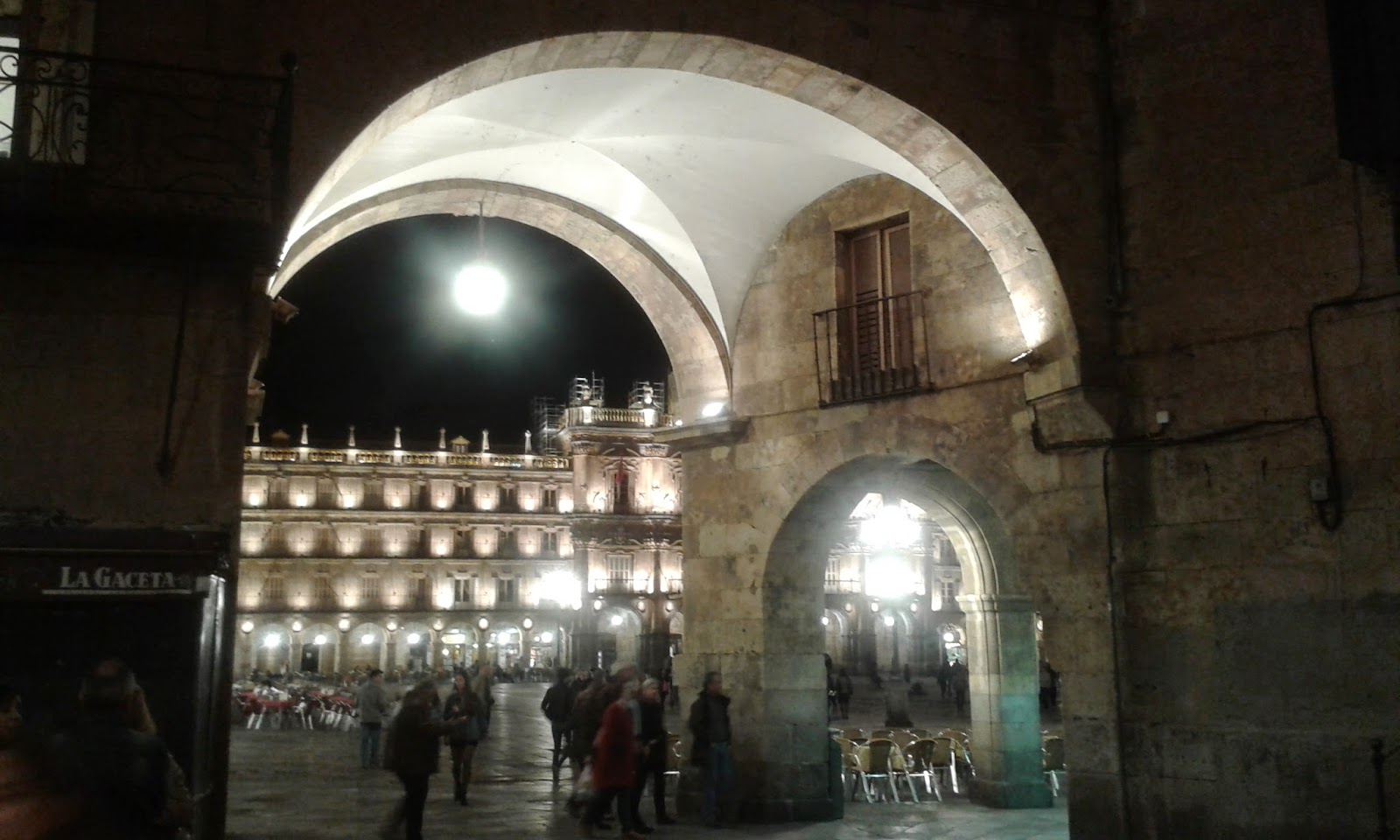
If Segovia is dominated by the cathedral and the Alcazar telling a lot about the power of the church and the nobility throughout history, Salamanca is even more religiously overwhelming. There are not one, but three great churches/convents, the cathedral counting actually for two, Romanesque and Gothic built side by side. Playing host to the third oldest university in the world (after Bologna and Oxford), it's all about schools and churches, but also a magnificent Plaza Mayor, a surprising Art Nouveau museum, nice cafés and great food.


I've seen so many interesting, surprising and unique architectural details, tasted delicious cheap tapas, enjoyed the spring sun at a calmer pace and promised myself I will definitely be back. For this I also have to thank the Mexican friend who graciously offered me shelter and his precious time and knowledge.

Yummy tapas: stuffed eggplant; pimiento del piquillo with cod; mushroom with goat cheese and jamón; zucchini with salmon, cream cheese and dry tomato + beer = 5 Euritos

The famous judiones beans with clams
The University or the Cathedral facade are obvious impressive examples of plateresco, this Spanish style the borders between late Gothic and Renaissance, but what I found most striking were the details and corners of so many buildings: the stairs, the vaults, the cloisters, the chapels. Great XVI century architect Rodrigo Gil de Hontañon (also author of the Segovia cathedral and the University of Alcalá) left behind two palaces: Salina and Monterrey, besides the new Cathedral and the monumental church of San Estebán, also a Dominican convent, that offered shelter and help to Christopher Columbus for quite a few years.

 Calle de la Compañia - one of the most beautiful streets ever

Catedral Nueva

Catedral Vieja amazing tower, looks like a Lord of the Rings fantasy castle

Some of the most stunning stairs I've ever seen, in San Estebán, by Rodrigo Gil de Hontañón

The old walls with the student vibe make an absolutely charming combination, and then there's the river, and the gardens, some impossible to describe chemistry that makes it such a pleasant and relaxing city.

That relaxing:)


A city where I felt comfortable just hanging out and doing nothing but looking around and smiling at the world in awe and gratefulness for my wonderful life, being granted so much freedom and joy. That feeling of looking at life through this kind of windows. Of the Art Nouveau museum eventually.


 Some of those gorgeous architectural details:


 Me in awe in the San Estebán cloister:

 Capitals:


The Sky of Salamanca that decorated once the ceiling of the University library is now hidden in a cloister just across, a few steps away from the hoards of tourists, in a quiet dark room. My sign, Virgo, stands proudly right in the middle.
Plaza de la Libertad is not a tourist highlight, just a picture pretty rectangular quiet square, lined with palm trees, geometrically cut cypresses and terraces, so welcoming and cozy. This charming gentleman was having his coffee (terrible like any coffee in Spain) with a cigar and glass of brandy...classy.


A place of perfect peace: Convento de las Dueñas, there was just another couple of visitors and I felt I could stay there for hours just enjoying the silence of the garden. At the exit there's a small shop where a nun sells traditional cookies homemade in the convent.

 The last image of perfection, Palacio Salina

Tuesday, March 31, 2015

SEGOVIA - YELLOW STONE TOWN AND SNOW CAPPED MOUNTAINS IN SPRING GREEN

There's something similar between Segovia and Salamanca, the light of their stones in the spring sun.

Although in Segovia there's more of Piedra del Parral and Salamanca Arenisca de Villamayor, I felt a certain warmth of the stone colour in both towns. They're sandstone types and in addition in Segovia the roof of the castle, Alcazar, is made of black pizarra/slate from the same area. For the first time I paid attention to how we built cities by using the nature around.

Many times the stones would come from nearby, as it would have been too difficult to carry them long distance. In Barcelona for instance the beautiful gothic church Santa Maria del Mar was made of blocks of stone brought from the close by hill of Montjuic by the port stevedores, on their backs. These two Castilla cities instead had around the type of rocks mentioned above.


There I felt peace and quiet, taking life at a slower pace myself. After all the running around in Madrid I took my time, for one day in Segovia, two days in Salamanca, to sit down, think and contemplate more. Seeing whatever I found on my way, without putting too much pressure and ticking lists.

It was quite fascinating to find out that queen Isabel la Catolica was actually crowned in Segovia and that Cristobal Colón - known as Columbus in English - met their Catholic majesties in Salamanca. There's so much history around, I felt like stepping on their tracks.

I landed in Segovia, name being of Celto-Iberic origin, before the Roman conquest, by mid-morning, after an interesting ride crossing the scenery of the Civil War, Sierra de Guadarrama and Valle de los Caídos. The setting is amazing,  I guess even more in spring, with the city raising in its warm light surrounded by snow capped mountains and the fresh shades of green brought by the season. Apparently Celts, Romans, Arabs, Jewish and finally Spanish found it all very appealing. As Segovia is not big and built on a rock about 1000 meters high, you get lovely different views as you make your way through the narrow streets.  Romanic churches, Plaza Mayor, the Jewish Quarter, are all dominated by three great landmarks: the Roman Aqueduct, built without mortar, the blocks of stone hold by themselves; the enormous late Gothic Cathedral and the elegant and solid Alcazar, the fortified castle that looks like a fairy tale one, especially if seen from the Eresma river bank, topping the abrupt rocks. Apparently the Sleeping Beauty Disney castle was inspired by it. Too bad they probably ignore the splendid mudejár decorations. Climbing to the terrace is rewarding the curious traveler with breathtaking panoramic views.


Wandering in the streets I found the less customary Gastronomic Museum, in some old house where every room tells a story about beans, chick-peas, wine, growing sheep and pigs and the by-products. Segovia is actually quite famous for its roast suckling pig and lamb and the huge white beans called judiones, not a bad idea for a consumable souvenir. The Gastronomic Museum also offers a small tasting of bread, cheese, jamón, sausage and wine, all very good, especially the jamón that happened to be made of a hairy sheep looking pig from Hungary, called mangalica. BThis and a delicious soup and a blue fish salad tapa at the Alcazar café made for lunch. Then eventually ventured out of the city walls to check on two Romanic churches, one now a convent.

It's also worthy for the sight of the high city and above all of the castle from below, plus you can take an enchanting walk by the river and re-enter through another gate. This way I found an incredibly beautiful and rather unusual Gothic façade of a convent, Santa Cruz la Real, that's now hosting an university. The famous and sinister first general inquisitor Torquemada was once a prior here.

All in all, small as it is, I still missed a few churches I wanted to visit and the Cathedral tower, so I have a good excuse for another visit.

Tuesday, March 17, 2015

SPAIN AGAIN, FOR A CHANGE - MUSING ON TRAVELLING, MADRID CULTURAL MARATHON AND MORE

MOVE - It's one of my strongest peremptory needs, if I sit still for too long I get anxious, and confined spaces drive me nuts. This need became evident when I read "Anatomy of Restlessness" by Bruce Chatwin, back in 2000. I understood then that travelling is like an inner call that natural born nomads have to follow in order to keep being themselves. Johnny Walker, keep walking! Even at work I need space, big windows, light, to see the sky and when possible trees to feel comfortable. I started taking lunch walks back in 2006 in Canada, half an hour is for eating, the other half is for moving, walking dramatically improves my well being.

On the other hand I also need a change of landscape, air, language, from time to time, it's like breaking up habits keeps my brain alive, and gives me a sense of freedom. At the same time big metropolitan centers also make me feel uncomfortable, caught between stone or concrete surfaces. I am less and less attracted by the idea of travelling to a city, may that be as fascinating as Berlin or Paris. Besides, they started being so similar, packed with hordes of tourists, crossed by metro lines, filled with Irish pubs, French bakeries and Italian fake restaurants next to horrible fast food or so called gourmet coffee chains. All big cities have a cathedral, national museums and world famous landmarks. I long for wide horizons, green meadows, thick forests and majestic snow capped mountains, surrounding small historical towns or picturesque villages. All with a bit of quiet and solitude, although it's already been said you can't feel lonelier than in the middle of crowds.

So having to take a week off by the beginning of spring I left aside the hypothesis of Amsterdam, Brussels, Lyon or Florence and decided to go to the closest cheapest flight destination: Madrid. Not only it's a big city, but I'm not even fond of it like I am of New York, Paris, Rome or more recently London. I am fond of its liveliness and mix of cultures though and only during this fifth or sixth visit I started to internalize its structure and subtleties, finding my favourite corners. Some of its best features are being reasonably close to Lisboa and playing host to great temporary exhibitions plus a good cultural alternative scene. Last but not least, quite a few friends call it a home and it's nice to see them after wandering all day by myself. Although being by myself didn't mean that I didn't talk to unknown people in the hostel or on the street. It's nice to enjoy all that time and temptations without having to please anyone else and be able to talk to someone around if you feel like, madrileños are quite social and easy going.


I wonder if during any of my former trips I was ever so conscious about how madly I can run all day covering kilometers, with very few and short stops, even to eat or sit down a bit. Why on Earth do I have so much physical energy to spend? Each evening would find me exhausted with my head busting with impressions and memories of the day. I didn't even count the number of exhibitions I visited and I was even scared of my hunger to see and learn more. On every trip I keep learning also about myself and my way of being in the world. At the same time I knew beyond the shadow of a doubt that it was also a form of escapism, of running away from my life. So putting this now on paper helps me saving something, giving it a sense.

Since the first day a friend took me to La Tabacalera former cigarette factory, now a cultural centre, and inspired me to take more abstract photos. I started looking around in a different way for the whole week. The way that objects are placed in an exhibition and how people deal with it. Putting out of the context certain parts and play with them. Then there were the social photographs at Caixa Forum, quite an amazing contemporary building . Photographs taken around the less charming nowadays Spain, portraits of guerrilleras from San Salvador or Afghan refugees in Greece next to heartbreaking images of refugees all over the world, especially from Africa and Middle East (Syria and Iraq) with their most prized possession since they left home with very little, could be a buzuk (music instrument), bracelets, a cane, a donkey, whatever gave them comfort on the way.

Later I got enchanted by the amazingly bright rainbow like paintings of Raoul Dufy who wanted to render light through colour, followed by the disquiet harmony and subtle anxiety of Paul Delvaux, both provoking the eyes and the mind in diferent ways.


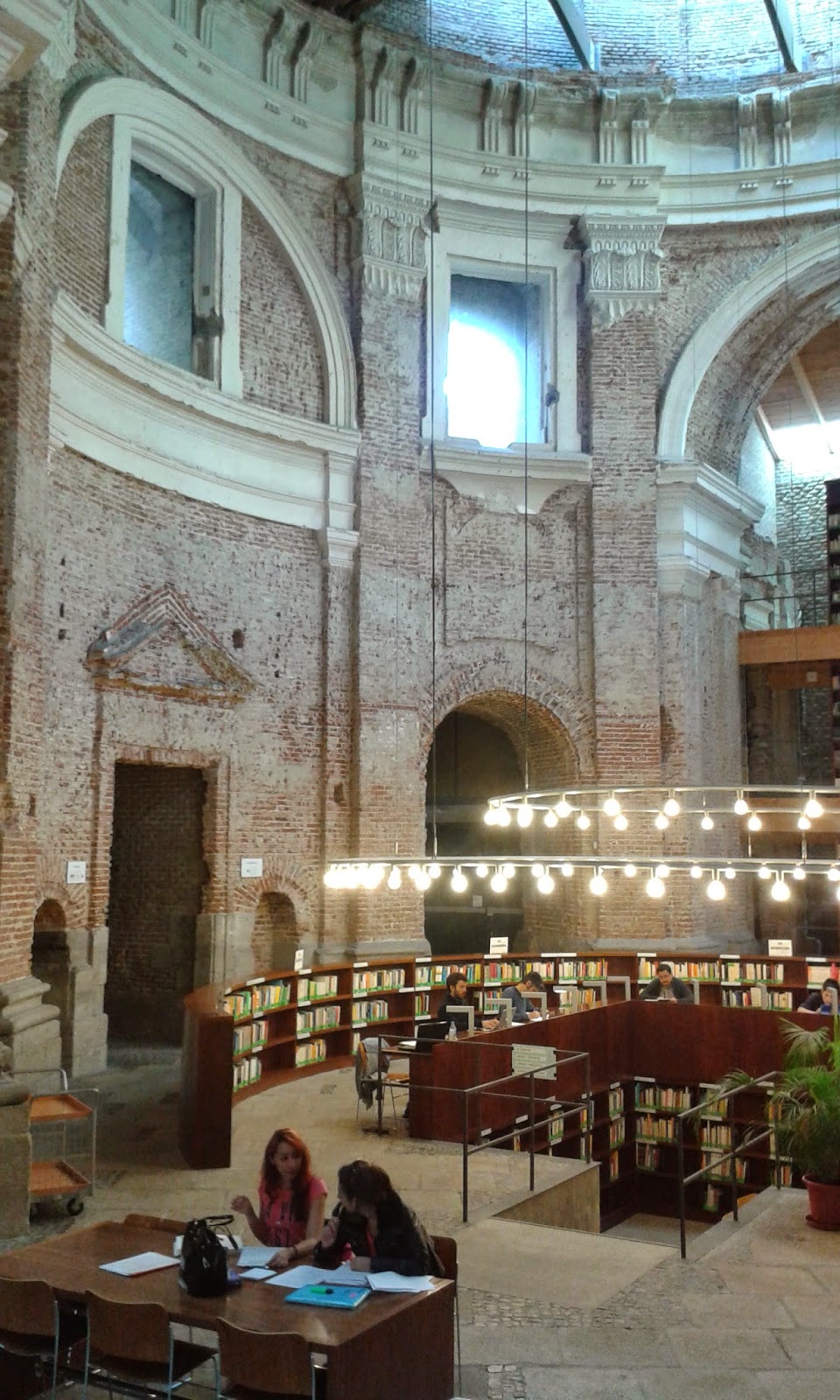
In between exhibitions I managed to fall in love with the Malasaña and Lavapiés colourful and kind of irreverent neighbourhoods, with the alternative shops and eateries of the first and the multicultural flavour of the second, especially the Mercado de San Fernando and the UNED library that used to be a church.

And when my mind was really crying for some green and some peace I walked along the Manzanares river green path and went to discover also Casa de Campo and Campo del Moro parks.


I couldn't resist paying another visit to Bosch, Goya, Ribera, my Museo del Prado favourites and I also discovered the history of Madrid in the city museum, quite interesting as it explored both its architecture and the social fabric of its inhabitants, customs and habits. Walking into yet another free cultural centre: Casa Encendida, I got acquainted to Colombian Suarez Londoño and his masterful sketch books drawings.

Just before taking the plane, and while looking desperately for a mailbox for my postcards, I managed to find time for the insightful Giacometti exhibition dedicated to the look: El hombre que mira, completed by very inspiring quotes on eye perception of the human body. I was very touched by an apparently simple drawing: an eye looking at a tree, that for me became suddenly the symbol of the wonder of spring.

And to top all this, I went twice to the theatre, as I managed to get a ticket, unbelievably, for Robert Lepage's "Needles and Opium", he's one of my favourite directors hailing from my former home Québec. Then it was an alternative play loosely based on "Fuenteovejuna" by Lope de Vega, that was actually quite weak, although the actors were making quite an effort.


When did I see my friends then? Well, some for lunch and a walk, some for dinner, for a tea, night drinks or an exhibition, or even host me for a couple of nights. It felt great and refreshing to see them and I guess I'll return to Madrid sooner than two years this time.

Monday, November 17, 2014

LONDON AT FIRST SIGHT

London is...Peter Pan, Mary Poppins, the Beatles, Shakespeare, the Thames, London Bridge, the Queen, the neo-Gothic Parliament, the Tube, Petula Clark singing "London is London". At least it was all this and much more in my mind before I got there. And obviously one week only allowed me to scratch the surface of this multi-layered metropole. Although in the end all big cities are somehow the same: multicultural financial, commercial and artistic hubs, filled with tourist traps and charming corners, packed with museums, immigrants, designer and souvenir shops...and amazing food from all over the world. I had a very weird feeling as many sights reminded me of North America, obviously it's Canada and the US that took after Britain, but it depends what you get to see first.

I could list a whole amount of things I wish I did when in London, like go out more at night, explore the immigrant neighbourhoods and the greener surroundings. On the other hand I did many other things that filled my heart with joy, especially that my partner in crime was my mom, to whom I promised this trip a long time ago.


Trafalgar Square
She studied English at the university, the Beatles are her favourite band, Shakespeare her favourite writer and her thesis dealt with science and pseudo-science in Chaucer's work. It was my dream to fulfill her dream and take this trip together. Turning 40 there felt like it was just the right time, 40 years also after she finished university. Not that she's satisfied now, I found out that Russia and the Red Sea corals and fish are still next on the list.


University mates, friends from Canada, Barcelona, a British ex-employer and a doctor friend from the cruiseships all live in this Babel Mecca now. Two of my Romanian friends there met me in Lisboa while travelling. So it was a great opportunity to see them all, catch up and eventually introducing them to each other, as three are Romanian single moms. Helping people becoming friends is one of my greatest joys. It all started with a college friend offering me accommodation responding to a Facebook announcement; last time we met at night on the street in Padova back in '99.

Saint James Park


Of course museums and luxurious beautiful shops like Fortnum&Mason are great sights, but somehow you can find similar ones in every other historical big city. If I was to make a top of the things I enjoyed most I would say theatre, the parks, the markets.


To me there's no theatre like the English theatre; lately I tend to favour more and more nature over buildings and I found the local markets to be lively and different, especially Camden Lock and Borough Market. I'm pretty sure I would have enjoyed the immigrant East and South areas but time was short and temptations plenty.

Borough Market
Camden Market


Plus, one of our best decisions was to visit Canterbury, host to the most important Anglican cathedral nd to Chaucer's colourful tales.

Whitstable
Whistable is a charming seaside town just half an hour away that was totally worth the detour even considering the sudden rain, that threw an amazing light over the sea. With all those North American reminiscences hitting every now and then, the lobster shack and the beach huts made me think of Cape Cod.

The green landscapes of Kent looked picture perfect, just like the charming XIX-early XX century looking shops, coffee shops and pubs. I felt respect for tradition and a certain way of doing things. People were mostly polite and cheerful, quite accommodating I would say.

English gastronomy may not be famous but I've discovered a whole variety of beers, great dairy products, cheeses like Stilton and Red Leicester and of course amazing oysters and real salmon, that I miss so much in Portugal where we only get some fake farm-raised Norwegian variety.

All together it was oh, so charming indeed! I'd definitely go back there for another round.

Monday, November 25, 2013

PERU - MINDBLOWING DIVERSITY AND HEARTMELTING HOSPITALITY (II Amazonia)

Between my arrival and the wedding I spent a few days, not enough, by far, in Iquitos and the selva amazonica. Just enough so I can get the taste of it, to miss it afterwards and long to go back. I picked Iquitos because of a Mario Vargas Llosa book I've read when I was a student: "Pantaleón y las visitadoras". Via Couchsurfing I got in touch with several possible hosts, finally one of them confirmed that he can receive me at his place. Another one said he can arrange for a less touristy stay in the selva, I imagined he would be my guide. That's all I had on the books when I got to the  small airport of the hot humid city of Iquitos, after an amazing plane ride, overlooking the most incredible mountainous landscapes, here there were snowy peaks getting through the clouds, there blue lakes among brownish green steep hills and valleys. Then we flew over the neverending Amazonian rainforest, like a sea of green, with rivers winding through it like roads in the fields. Actually the only way to reach Iquitos it's either by boat or by plane, the road won't take you that far, even to a city that's home to over 40,000 people. 

Outside a car waited for me with Ulises and David, most of the taxis though were moto rickshaws, traffic was crazy and the buses didn't have windows. I didn't understand what was going on until we got to Ulises' agency, Carrusel Tapira. Oops, instead of an independent tour I was to go on an organized one, which disappointed me really, but I didn't have much time to look for something else, and on the other hand they seemed to be really nice and knowledgeable, Ulises being the son of a Peruvian and a Brazilian from the other side of the Amazon, a true river creature. Besides, we were few, just three all together, with a Catalan and his Peruvian girlfriend. David got me a rickshaw to take me to my hosts and we agreed on leaving next morning. My Couchsurfing hosts, Pavel and Joanna, are two young Poles living in Iquitos, both kind, with beautiful smiles and amazing sparkling blue eyes. They have a small studio apartment, with cold water shower, a kitchenette and a half working fridge. After I invited them to a deliciously refreshing ceviche lunch accompanied by cocona fruit juice, they took me out to the Nanay river market, Bellavista. It was probably the most exotic I have ever seen so far, sporting grilled cayman and palm worms (suri), Amazonian chestnuts, unknown fish and fruits, turtle eggs and so on. I tasted the suri, it was somehow sweet, not unpleasant, but not fantastic either. The aguaje palm fruit is usually peeled and eaten with salt, or made into a refreshing juice. I also saw ubos and camu camu, besides the well know papaya and mangoes that smelled like heaven on earth.


We took a boat with a beautiful roof made of braided palm leaves to Padre Cocha, for a cool beer on a floating deck, where local were swimming sometimes fully dressed, I imagine it would keep your clothes cleaner a longer time.   


After a chocolate crepes dinner I left the next morning to my dream destination: la selva del Amazonas. Not on a raft like in Jules Verne's 800 lieues sur l'Amazone, but on a small passenger boat, with Ulises and my fellow travelers, Jordi from Catalunya and his Peruvian mountains lover, Denisse. After a couple of hours we arrived in a tiny place where Ulises went to buy food for our stay and we had to wait for the motorized canoe that was to take us to the lodge. While we were waiting I strolled through the quiet village, bought some aguajes  from a broad smile girl, some kind of corn cakes from a couple of schoolgirls and a few sapotes (a big sweet fruit with an orange pulp) to eat later. Being tall and Caucasian, with a Nikon in my hand and walking by myself, I couldn't do anything not to look exotic, so people looked at me with curiosity. It occurred to me that it would feel probably the same if I were in some remote Romanian village.    

The canoe came after about an hour or so and the seven of  us (Jordi, Denisse, Ulises, our cook, Delicia, her partner and handyman and their child) navigated for a while on the broad light brown Amazonas and then turned right on a smaller river that led us to the path heading to the lodge. We were handed botas de jebe/gum boots and went through mud, crossing some pools over shaking planks, under the amazingly high trees canopy, surrounded by the lush green forest and funny wild life sounds. The entrance to the clearing were stood our bungalows was framed by two majestic trees that I could only compare to a Gothic cathedral. The accommodation was not suited for the faint of heart and comfort lovers, there were two breezy typical huts, built on stilts to keep them above water and snakes, without electricity. Made of tree trunks, palm and banana leaves, a big open one was meant for eating and partying, the other, with full walls, for sleeping, cooking and a rainwater shower.

I spent there four exciting and at the same time quiet days, going to bed early and reading with the help of my pocket lamp, waking up within the first morning hours, trying to tell the different jungle sounds, birds, monkeys and God knows what else. Delicia honoured her name and prepared simple great food every single day, over a wood fire, from Amazonas sardines to sauteed noodles, even her rice was cooked to perfection. We had fresh fruit juices, sometimes from plants around the huts, like sugarcane and cocona.  


Raul took us around the surrounding selva, not too far in, during the say and during the night. It felt like walking in a strange cathedral, as the trees canopies were so high that they looked like massive pillars with huge roots sometimes, all surrounded by bush and entangled lianas. It made us feel small and fragile, exposed and vulnerable, but the guide's self assurance and calm helped us a good deal.


We discovered healing plants like the pichirina, good for the stomach, and monkey ladder (escalera de mono), good for sores and skin infections. We learned about parasite/strangler plants and admired their capacity to climb upon big trees up to the top in the search of light. Then we marveled at the many types of spiders and ants, the families of squirrel monkeys (saimiri type), the size of the snails or the enormous toads.


Probably the most impressive creatures were the tarantulas that didn't look that scary to me, but rather endearing, all fuzzy and rather quiet.


Advancing over water was a whole different story, especially through the flooded forest, four of us in one canoe, with the help of the machete. Quite spectacular and very Indiana Jones like.


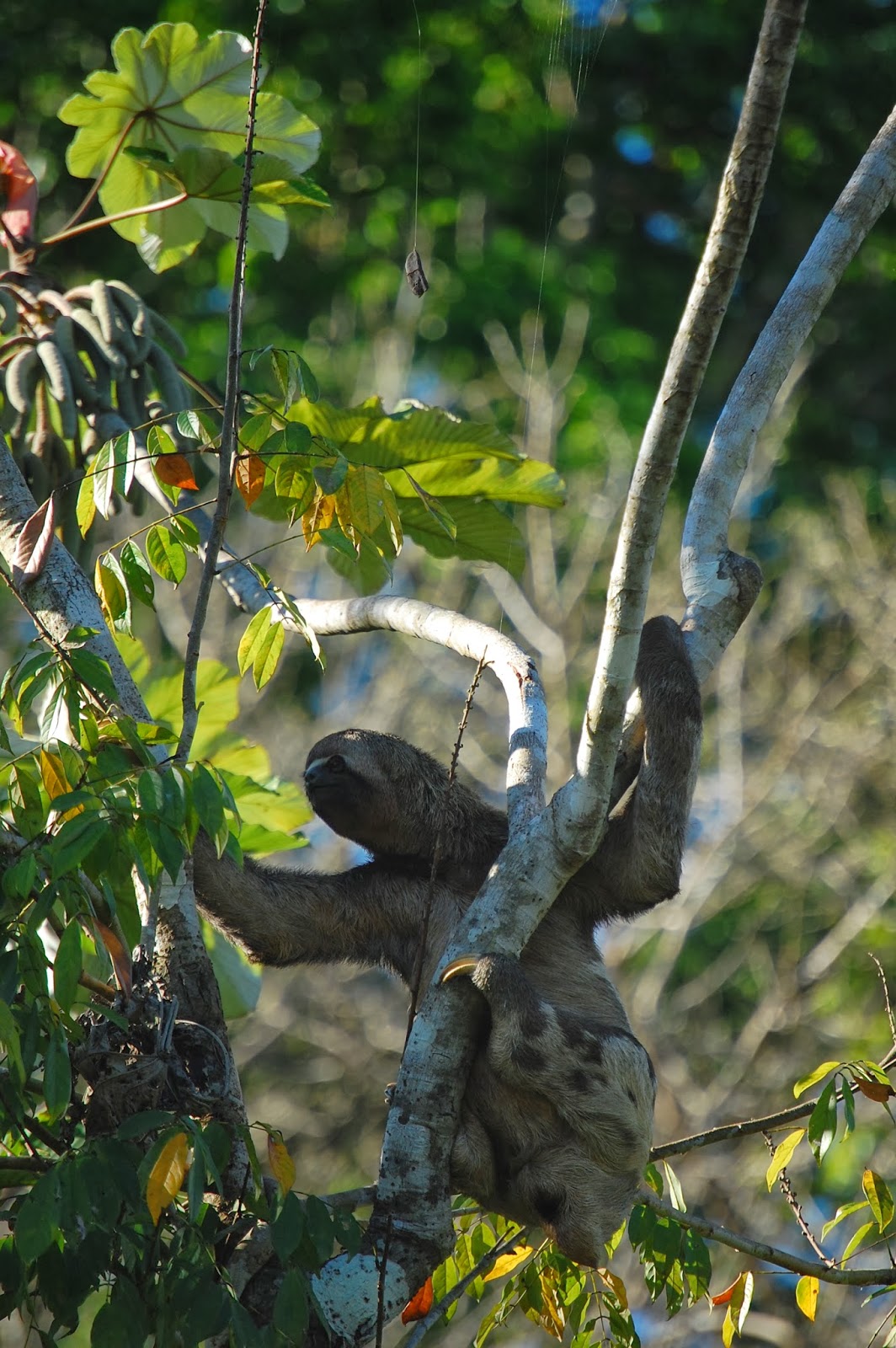
And the amazement wouldn't stop here. We saw a beautiful boa strangling its prey, a vulnerable sloth (in Peru they call it pelejo), up in a tree. The sloths move very little and at a very slow pace because their diet made exclusively of leaves does not provide many nutrients, so they are "programmed" to spend very little energy. They are an easy prey for huge snakes then.

Apart from a small toucan we saw beautiful woven nests hanging from trees, belonging to colonies of oropendolas or paucars (yellow-rumped cacique), both sporting black and bright yellow colouring. Raul explained us that another feathered fellow, the cowbird, lays its eggs in the oropendolas nests, their chicks eating a harmful parasite fly and its larvae that would otherwise harm the host's chicks. A beautiful symbiosis example.

On the longest day we got to a hidden pond covered by huge Victoria Regia leaves (a type of waterlily), unfortunately only one of them was in bloom. Raul showed us how to fish by spear, another technique I saw only in Amazonia. On the way back we had to drag the boat through Raul's small village, Centro-America, set up by his grandfather,  to shorten the trip. One night we went searching for caimans and got caught by a tremendous rain (actually it was raining every single day, alternating with sun, and our clothes stayed kind of damp all the time). The night after Raul simply plunged his hands into the water, and after a short struggle he was holding a small caiman, we convinced him to throw it back in, he was thinking about taking it to the river next to the village. That simple. Those people lives look so adventurous to us, to them is just a hard daily routine, Raul had a scar on his face from a caiman's tail strike, the main danger when you try to catch one, he told us.

On the last day we paid a visit to Centro-America, tasted the local homemade alcohol, chuchurrin, and saw how people actually live, many times in houses that looked rather like verandas, with half built walls, cooking and sleeping in open spaces. It was also our only opportunity to see a dead piranha lying on a veranda. There were some small solar panels, rented by a company for an amount that  was ridiculous to us. They were enough to get a few hours of light at night time.  When the water floods the village during rain season, sometimes people have to look for shelter on the roofs. In 2012 the water flooded the living space and in Raul's bedroom they found catfish (doncella), boas and even electric eels. When we went there, beginning of February, there were hardly any ripe fruits, except lemons, and hundred lemons would just pay enough for them to get to Iquitos and back. Mangoes and papayas were not ripe yet. We understood that they actually live on a yucca, rice and fish diet most of the time, and cash is hard to get unless you work with tourists. Teachers at the local school only stay for a very short time before they return to the city.

So these few days were filled with teaching and learning, in many ways, sometimes just by looking around or observing people's attitude towards life. I never heard them complaining for instance, saying this is not the life they deserve. The lessons I learned are in Amazonia are, above all, to keep silent, to be patient and move in slow motion. It applies to observing wild life, but also to our everyday exchanges.

My peak moment was getting to swim in the actual Amazon, just meters away from gray and pink dolphins, they actually came closer as me and Jordi got into the water. It was more than I ever dared to dream. I would go back there any time, and I would chose to stay in the village, go to the natural park Pacaya Samiria or camping, not in a jungle freaking lodge!

Wednesday, January 16, 2013

WINDS OF CHANGE, THERE'S NO HOME BUT TRAVELING

Tel Aviv  - Yafo
My life simply doesn't want to stand still since I came back from Canada, almost three years ago. It twists and turns like a fish on dry sand, trying to reach back to the water. 

When I was working on cruiseships a  key phrase during emergency drills was "reach your final destination". On the ship it was easy, it meant a little square from where we were supposed to get on life boats or rafts.  But in life on solid ground it looks like my real final destination doesn't want to be found. I finished much less than gloriously my cultural promotion mission in Portugal, on the ground of dramatic political and administrative changes in my motherland. I can't call it homeland as I don't have a home for now, or, again, since I left Canada. Which is also arguable as my rent appartment felt like home, not the country per se. 

After spending Christmas in Bucharest with my beloved mother, sister and brother, plus some extended family members, I went to Israel to end up a conversation. It started in the Madrid subway with an Israeli song author, video-editor and aspiring writer, about a year before and we kept in touch only via Facebook, getting acquainted through our photographs, phrases, likes and dislikes. I decided to take up his invitation to visit a contrasting and controversial country. It was not meant to be a pilgrimage, but I didn't discard the idea of making it part of the whole experience. I was richly rewarded for this decision. I received so much love and positive energy during this trip that I can hardly describe how much it enlightened my mind and my soul.

I don't know if this is the Holy Land...all land is holy, as long as people don't spoil it with their changes. I felt amazingly in the desert, on the shore of the Kinneret Lake (Sea of Galilee) or in the Ein Gedi Park.

Lake Kinneret

Judean desert


And I met amazing people, that treated me with such effortless genuine kindness that I am still in awe, regardless of being Israeli or Palestinian,  religious or not, Christian, Jewish or Muslim . This trip above all restored my trust in the human race. Especially that I was in conflictive area, and I expected the inhabitants to be more nervous and impatient. It was a real life lesson, about the beauty of nature and the human kind. It's hard to explain, but I felt pure unconditional love flowing towards me.So in these terms I would advise anyone to go there, regardless also of their nationality or faith. 

I deeply appreciated the cosmopolitan vibe of Tel Aviv, its colourful market, white beaches and modern looking leisure port. Here and there one can see interesting Bauhaus buildings and wander on Rotschild Boulevard or hang out in lively neighbourhoods like Neve Tzedek, Sheinkin street or Florentin. I was very  lucky to have such good hosts there. 

And so was I in Bethlehem, on the Palestinian side of the story, spending time with a Christian family and taking a day trip around with a Muslim taxi driver and tour guide, a former history and geography teacher. I saw bedouins on donkeys and horses, a desert monastery, the Shepherds' Field, Solomon's Pools and the ruins of a Herode's palace in a record time, with a great guide, who spoke decent English and knew plenty of stories. The Nativity church is simply beautiful but really rundown, and most visitors were paying less attention to its beauty and more to the basement stone were Jesus was supposed to be born. I was shocked to see the caretaker washing the Byzantine mosaics with a dirty mop. But I guess this is as much as they have. Life is far from being easy there, but smiles are for free. 

Then there is Jerusalem, with its confusing old city, made of the Muslim, Christian, Jewish and Armenian Quarter. A true 1001 nights experience, especially on the market (souk) streets, some shops look like Ali Baba caves and you can sample many delights of the Middle Eastern exotic and flavourful world. I had a hard time getting the Christian vibe of the place, except for the hundreds of pilgrims that insisted in living in their own pious bubble. The churches were assaulted by hordes of passionate Christians, clicking desperately on their phones and cameras button, like there was no tomorrow. The next best thing to do was to touch whatever stone or image was supposed to be the holiest of the place: where Jesus died, wept, stepped, where Mary was born, were Mary died, etc., like on a freaking film set. No corner to recollect and reconnect, which for me gives sense to a pilgrimage. Most cathedrals show signs of their impressive age, old grey smoky walls with hardly any signs of painting, old icons and beautiful ancient lamps. My biggest frustration was not seeing the so called Dome of the Rock big mosque, an ancient piece of pure architectural beauty. On Friday and Saturday it is closed to non-Muslims.

The newer Israelian side also hosts a bustling market, Mahane Yehuda, full of goodies of all kinds and a central fun zone, with pedestrian streets and nice hang out coffee shops and bars. I had no time for museums, but for a first visit I think I had plenty on my plate. 

To me though the best experiences were the moments I spent out of the cities: Kinneret Lake, Judean desert (old Mar Saba monastery), the Ein Gedi oasis and national park, the Dead Sea shore, the Massada ruins. Nature is a gift of God to the humans troubled soul and restless mind.

Search This Blog